›
›
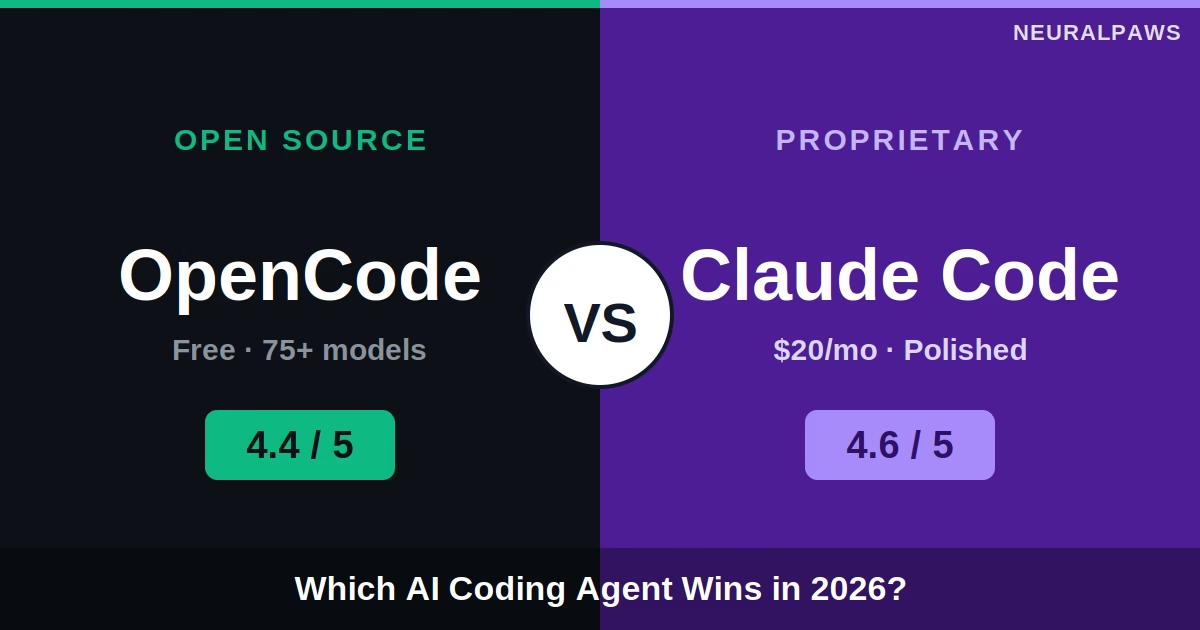
Bottom line: OpenCode is the most compelling open-source coding agent of 2026 — free, model-agnostic, and yours to audit. Claude Code is more polished and better-optimized if you’re happy inside Anthropic’s ecosystem and don’t mind paying for a managed plan. For flexibility and cost control, OpenCode wins; for a frictionless out-of-the-box experience, Claude Code still leads.
What Is OpenCode?
A note on this review: I haven’t yet run OpenCode across a full production project, so treat this as a research-based first look rather than a months-long field test — I’ve pulled together the specs, benchmarks, pricing, and the real trade-offs other developers are reporting, plus how it stacks against the tools I do use daily like Claude Code and Cursor. When I’ve shipped real work with it, I’ll update this with hands-on notes.
OpenCode is an open-source, terminal-native AI coding agent built by the team behind SST (now Anomaly). It runs locally on your machine, stores conversations in SQLite, and connects to 75+ AI providers — Anthropic, OpenAI, Google, AWS Bedrock, Azure, Groq, OpenRouter, and local models via Ollama. The MIT license means you can inspect, modify, and self-host the entire system.
The scale of adoption is what makes it hard to ignore. OpenCode crossed 180,000 GitHub stars in 2026 — making it the most-starred open-source coding agent, ahead of Claude Code, Gemini CLI, and OpenAI Codex — with over 7.5 million developers using it monthly. The appeal is simple: model-agnostic, terminal-native, fully open source, and you own your data.
The core difference from Claude Code comes down to philosophy. Claude Code is Anthropic-only and proprietary but tightly optimized; OpenCode is provider-agnostic and open but requires you to bring your own API keys and do a little more setup yourself.
Key Features
Here are the features that define OpenCode in 2026:
Killer feature
75+ Provider Support
Use any model for any task — Claude Sonnet for complex refactoring, a cheap Gemini Flash for routine edits. Switch models mid-session. No vendor lock-in.
Unique
LSP Integration
Language Server Protocol feeds real compiler diagnostics back to the model after every edit — reportedly no other agent does this.
MIT Open Source
Read every line of source. Critical for security-conscious teams that must audit their tools before adoption.
Air-Gapped / Local Models
Run entirely on local models via Ollama or LM Studio — code that legally cannot leave the machine stays put. Built for finance, healthcare, defense.
Background Subagents
Spin up background agents plus a “Scout” agent for external research, working alongside your main session.
Local SQLite History
Conversations stored locally in SQLite — your data stays on your machine, not a vendor’s servers.
Pros & Cons
✅ Pros
- Free and MIT open-source — audit the whole thing
- 75+ providers, zero lock-in
- BYOK: pay only your provider’s token cost, no markup
- Local-model support for air-gapped work
- Most-starred open-source agent (180K+)
- LSP compiler feedback loop
❌ Cons
- Terminal-only — no graphical diff, no inline completion
- Less polished than Cursor’s IDE experience
- Requires manual provider/API-key configuration
- ~78% slower than Claude Code on the same model (Builder.io test)
- Smaller community than Claude Code for support
Pricing Explained (2026)
OpenCode’s core is free; your real cost is model tokens. Here’s how the options break down:
| Plan | Price | What You Get | Best For |
|---|---|---|---|
| Free (BYOK) | $0 | Full agent, all features. You supply provider API keys and pay their token rates. Local models via Ollama = near-zero marginal cost. | Most developers |
| OpenCode GoCheapest managed | $5 then $10/mo | Bundled access to open models (GLM, Kimi, Qwen, MiMo, DeepSeek) without wiring up providers. Currently in beta. | Skip API-key setup |
| Zen Pay-As-You-Go | ~$20 balance | Pre-paid balance with zero markup on model access — pay provider cost directly, no key management. | Teams wanting no markup |
OpenCode vs Claude Code vs Cursor
Here’s how the three stack up in 2026:
| Feature | OpenCode | Claude Code | Cursor |
|---|---|---|---|
| Price | Free (BYOK) | Pro $20/mo | Free / $20 / $40 |
| Open source | ✓ MIT | ✗ Proprietary | ✗ Proprietary |
| Model choice | ✓ 75+ providers | ✗ Anthropic only | ~ Claude/GPT/Gemini |
| Interface | ~ Terminal only | ~ Terminal + IDE | ✓ Full IDE |
| Local / air-gapped | ✓ Yes (Ollama) | ✗ No | ✗ No |
| Terminal-Bench 2.1 | ~ Model-dependent | ✓ 78.9% (Opus 4.8) | ~ Mixed |
| Polish / ease of setup | ✗ Manual config | ✓ Managed | ✓ One-click |
| Data ownership | ✓ Local SQLite | ~ Vendor-managed | ~ Vendor-managed |
Claude Code wins on polish, out-of-the-box optimization, and benchmark performance — it scores 78.9% on Terminal-Bench 2.1 with Opus 4.8, one of the top usable pairings. Cursor wins if you want a full graphical IDE rather than a terminal. OpenCode wins the moment you care about model flexibility, cost control, open-source auditability, or running code that can’t leave your machine. If you already use Cursor, it’s worth reading our full Cursor AI review alongside this — many developers run both. And once code ships, our Daemons by Charlie Labs review covers the always-on layer that picks up the maintenance work afterward, regardless of which coding agent wrote the PR.
Performance Ratings
Who Should Use OpenCode?
✅ Great fit
Developers who value open-source software, want to mix and match models (Claude, GPT, Gemini, DeepSeek, local), or need tight cost control via BYOK. It’s an especially strong pick for security-conscious teams in finance, healthcare, or defense who need air-gapped local models for sensitive code, and for anyone tired of vendor lock-in.
⚠️ Think carefully
If you want a polished, graphical, low-setup experience, Cursor or Claude Code will feel smoother — OpenCode is terminal-only with no visual diff view and requires manual configuration. And if raw speed on the same model matters more than flexibility, Claude Code is meaningfully faster.
Final Verdict
OpenCode is the best open-source terminal AI coding agent available in 2026. Its multi-provider support, BYOK model, local-model compatibility, and zero core cost make it hard to beat for developers who prioritize flexibility, privacy, and control. The trade-offs are real — it’s less polished than Cursor, slower than Claude Code on the same model, and needs manual setup.
Against Claude Code specifically: pick OpenCode for openness, model choice, and cost; pick Claude Code for polish, speed, and a managed experience. Many developers, sensibly, keep both.
Recommendation: If you’re comfortable in a terminal and want maximum control with minimal cost, install OpenCode today — the core is free. If you want the smoothest ride and live in Anthropic’s ecosystem, Claude Code is worth its $20/month.